Why Your Blog Posts Never Rank on Google: You're Ignoring Search Intent
You've added keywords. You've written long posts. So why isn't your blog ranking? The answer is Search Intent — the single most overlooked SEO factor by everyday bloggers. Learn the 4 types of search intent and how to use them to finally get found on Google.

You've packed in the keywords. You've written thousands of words. You've even checked off every item on an SEO checklist — and still, your blog sits on page 5 of Google with barely any traffic.
So what's going wrong?
The answer, more often than not, is Search Intent — and it's the one thing most everyday bloggers completely overlook.
What Is Search Intent?
Search Intent (also called "user intent") is the underlying reason why someone types a query into a search engine. It's not just what they searched — it's what they actually wanted to find.
Take the keyword "diet tips" as an example. Someone searching this phrase isn't looking for a medical textbook definition of dieting. They want practical, actionable tips they can use today. If your post opens with a five-paragraph history of the diet industry, you've already lost them — and more importantly, you've lost Google too.
Google's core mission is to match users with the content that best satisfies their intent. This means if your content doesn't align with what people are actually looking for, no amount of keyword stuffing or meta tag optimization will get you to the top.
The 4 Types of Search Intent
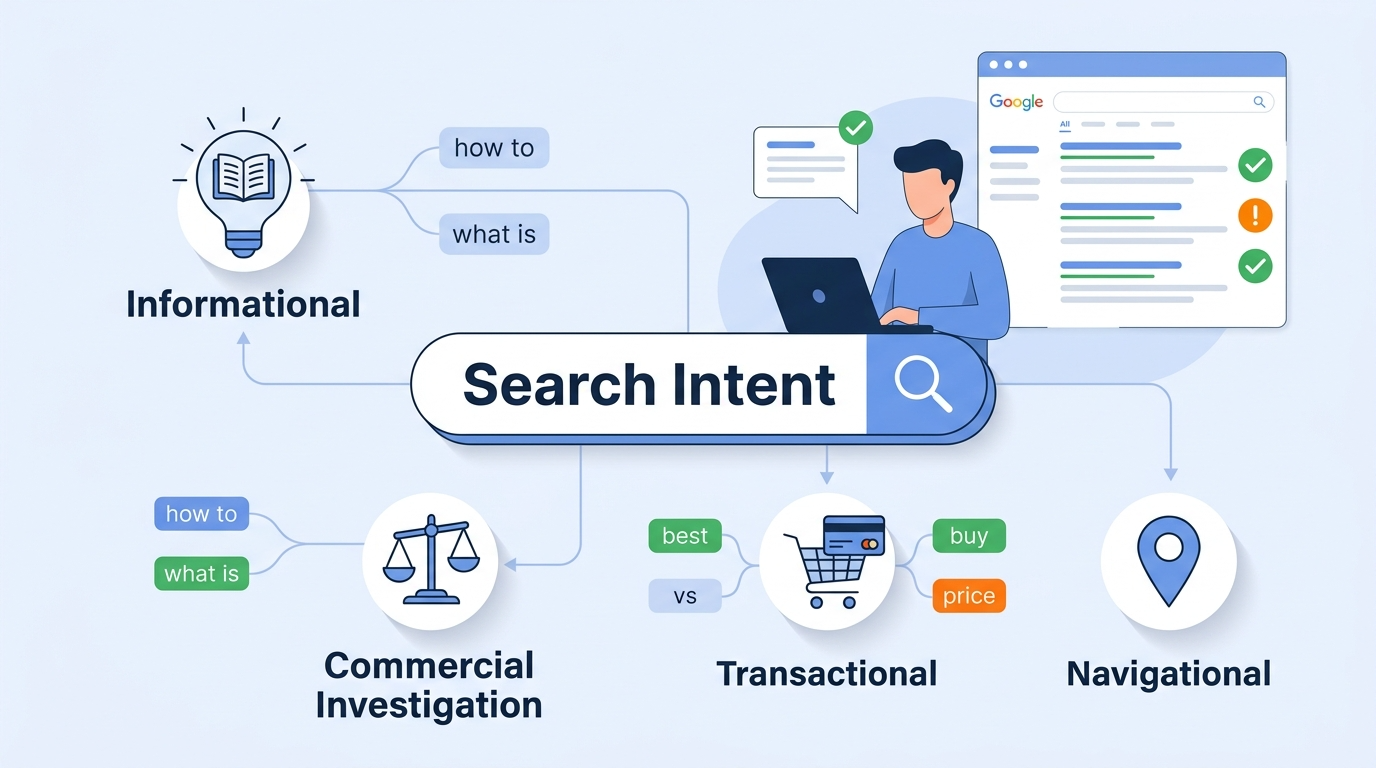
Understanding search intent starts with knowing its four main categories. Every keyword your audience searches falls into one of these buckets.
1. Informational Intent
This is the most common type for bloggers. The user wants to learn something. Keywords often include phrases like "how to," "what is," "why does," or "guide to."
Examples: "why is my cat vomiting," "how to learn Python," "how to get rid of fridge smell"
For this type, your content should educate. Go deep, explain clearly, and provide real value. A well-structured how-to guide or explainer post works best here.
2. Commercial Investigation Intent
The user is researching before making a decision. They're comparing options and looking for recommendations. Keywords often include "best," "vs," "review," or "top."
Examples: "best air fryer 2025," "MacBook vs Samsung laptop," "Notion vs Obsidian review"
Here, your content should help users compare and choose. Comparison tables, pros and cons lists, and honest personal recommendations work extremely well.
3. Transactional Intent
The user is ready to take action — whether that's buying, signing up, or downloading. Keywords often include "buy," "price," "discount," "coupon," or "sign up."
Examples: "buy Nike running shoes," "gym membership near me," "Canva Pro discount code"
While e-commerce sites dominate this space, bloggers can still win with detailed product reviews, affiliate content, and strong calls to action.
4. Navigational Intent
The user is trying to reach a specific website or brand — like searching "YouTube login" or "Notion app." This type is nearly impossible for general bloggers to compete with, so it's best to focus your energy on the first three.
The Easiest Way to Identify Search Intent
You don't need expensive tools to figure out the intent behind a keyword. Just search the keyword yourself on Google and look at the top 5–10 results.
- If most results are detailed how-to guides → Informational intent
- If most results are listicles or product comparisons → Commercial intent
- If most results are product pages or store listings → Transactional intent
- If the top results are all videos → The keyword may not be well-suited for a text-based blog post
The content already ranking on page one is essentially Google telling you: "This is the format and approach users want for this keyword." Use that as your blueprint.
Real-World Example: Same Topic, Different Intent
Let's say you want to write about "home café recipes."
If the people searching this keyword want quick, easy recipes they can try at home, here's how different content approaches stack up:
| Approach | Verdict |
|---|---|
| History and global trends of home cafés | ❌ Interesting, but misses the intent |
| Deep dive into coffee bean varieties | ❌ Related, but not what they're looking for right now |
| 5-minute dalgona coffee recipe (no equipment needed) | ✅ Directly matches intent |
| 7 café-style drinks you can make without an espresso machine | ✅ Directly matches intent |
No matter how well-written your post is, if it doesn't match what the reader came for, they'll bounce — and Google will notice.
How to Structure Your Content Based on Intent
Once you've identified the intent, build your content structure around it.
For Informational posts, follow a logical flow: Why → What → How. Your reader wants to understand something, so don't skip the context. Walk them through the reasoning before jumping to conclusions.
For Commercial posts, lead with the answer. Readers comparing products are busy and want clarity fast. State your top recommendation upfront, then justify it. Don't make them scroll through five paragraphs before they get the point.
For Transactional posts, focus on trust and action. Include real-use experiences, honest reviews, and a clear call to action. The reader is ready to commit — your job is to make them feel confident doing so.
3 Common Mistakes Bloggers Make
Mistake #1: Writing for yourself, not your reader.
Your blog isn't a personal journal (unless that's the goal). If you want SEO traffic, every post needs to start with one question: What does my reader actually need from this search?
Mistake #2: Focusing only on keyword placement.
Dropping your target keyword in the title, intro, and a few headings is not a strategy. Google has moved far beyond counting keyword frequency. What matters now is whether your content genuinely satisfies the user's query — from start to finish.
Mistake #3: Skipping competitor analysis.
Before you write a single word, look at what's already ranking. The top results tell you exactly what format works, how long the content should be, and what questions need to be answered. Ignoring this step means you're writing blind.
Final Thoughts
At its core, SEO isn't just a technical discipline — it's an exercise in understanding people.
Before you write your next post, ask yourself: Why would someone search this keyword? What problem are they trying to solve? What would genuinely help them? Write the content that answers those questions better than anyone else, and Google will reward you for it.
The next time you sit down to write, don't open a blank document first. Open a search engine, type in your keyword, and let the results show you exactly what your audience is looking for.
Found this helpful? In the next post, we'll cover how to write SEO-optimized titles and meta descriptions that match search intent and actually get clicked.
